


Ready to build is tech talent that can start building today: certified, available and able to join any kind of project in days, not months. The state is not declared by the person themselves. It is backed by an external certification process they have already passed.
On a talent card, a badge that reads ready_to_build can look like platform marketing. It is not. It names a state with a process behind it, and that state is the difference between one more CV and a person who comes in to build. The badge does not promise maturity; it documents it.
The cost of waiting is paid in both directions. The project with the budget signed and nobody to start it. The quarter that closes while selection is in its sixth week. The hardest decision of an approved project is almost never technical: it is how much waiting you accept before the window closes.
Ready to build is the state of tech talent that is certified, available and able to join any kind of project in days. It is backed by an external process, not a statement by the person: certification of identity, experience and technical skills, real availability and a senior track record. Shakers marks it with the ready_to_build badge on the card of every certified talent, the platform literal written together with an underscore. Thousands of professionals apply every year and only 4% pass the process. And it answers a measurable pressure: 40,400 active tech postings in the UK (Shakers analysis, June to September 2026) and 5% of companies getting value from AI at scale (BCG, 2025).
Where does the term ready to build come from?
From the need to name a state the market was already looking for without a word for it. Any team that has started a project in a hurry knows the difference between a CV that says "immediately available" and a person who can come in tomorrow to build. What was missing was a short way to name the second one. Ready to build is that: three words that sum up a state of talent, not a promise.
At Shakers the state is born as a platform label, and that is where its spelling comes from: ready_to_build, written together with an underscore, is the literal the system assigns to the card of certified, available talent, like an order status. In prose it is written apart, ready to build. Both spellings mean exactly the same thing.
What makes talent ready to build?
Three conditions, and none of them is a CV adjective:
| Condition | What it means | What backs it |
|---|---|---|
| Certification | Identity, experience and technical skills reviewed and passed | An external process, not the person themselves |
| Availability | A current, visible state, not "open to opportunities" | The platform, updated when it changes |
| Versatility | Joining any kind of project without a long settling in period | The talent's senior track record |
The first condition is the hardest one. Thousands of professionals apply to join Shakers every year. Only 4% pass our certification process, which reviews the three pillars always in the same order: identity, experience and technical skills. The other two are not declarative: availability is a state visible on the platform, updated when it changes, and versatility is earned by joining projects midway through their start. It holds for development, data, cloud and enterprise platforms. The AI Builder is the most visible case because the badge was born with that certification, but the condition is the same for any specialist.
How is it different from available talent?
In who backs the state. The full difference is here:
| Criterion | Available talent | Ready to build talent |
|---|---|---|
| Who backs the state | The person themselves, on their CV or profile | An external certification process the person passes |
| What evidence exists | A line of text: "immediately available" | Identity, experience and technical skills certified |
| When they can start | It depends: weeks of process every time | In days, on any kind of project |
| What happens on each new project | The process starts from scratch | The certification is already done; what remains is the match |
"Immediately available" is the most repeated phrase in tech CVs, and its problem is not that it lies. It is that it does not discriminate: when everyone writes it, nobody stands out. What changes the decision is the backing: behind the badge there is talent certified in AI skills and an auditable process, not a statement by the person. That is the difference between a list of candidates and a hiring infrastructure to lean on.
Why does start up speed matter?
Because the bottleneck of AI projects is not the decision to invest. It is the months between the decision and the first deliverable, the gap the industry calls the implementation gap. According to BCG's Build for the Future 2025 study (September 2025, n=1,250 companies), only 5% of companies get value from AI at scale and 60% achieve no material value despite having invested. Most of those projects did not fall over on technology. They fell over on time.
The market gives no quarter either. According to the Shakers market analysis, the UK tech sector holds 40,400 active postings (n=40,400, between 13 June and 11 September 2026): every project competes for the same senior talent, and whoever takes weeks to close their team loses the window the budget had already opened. That is where the term earns its operational meaning: ready to build talent turns the start into a decision of days, with the certification solved before the project existed. It does not promise a faster selection process; it removes what made it slow.
How does a company work with ready to build talent?
The mechanism is short:
- The company defines the project: scope, stack and delivery windows.
- Shakers presents certified talent with the ready_to_build badge and their availability status in plain view.
- The collaboration starts in days, with a single contract behind it: one provider, ISO 27001 and an NDA before any access.
The badge is carried above all by one kind of profile: the AI builder, the profile that builds product on top of already trained models. If that term also sounds like several things at once, its definition has its own piece: What is an AI builder, the sister of this one.
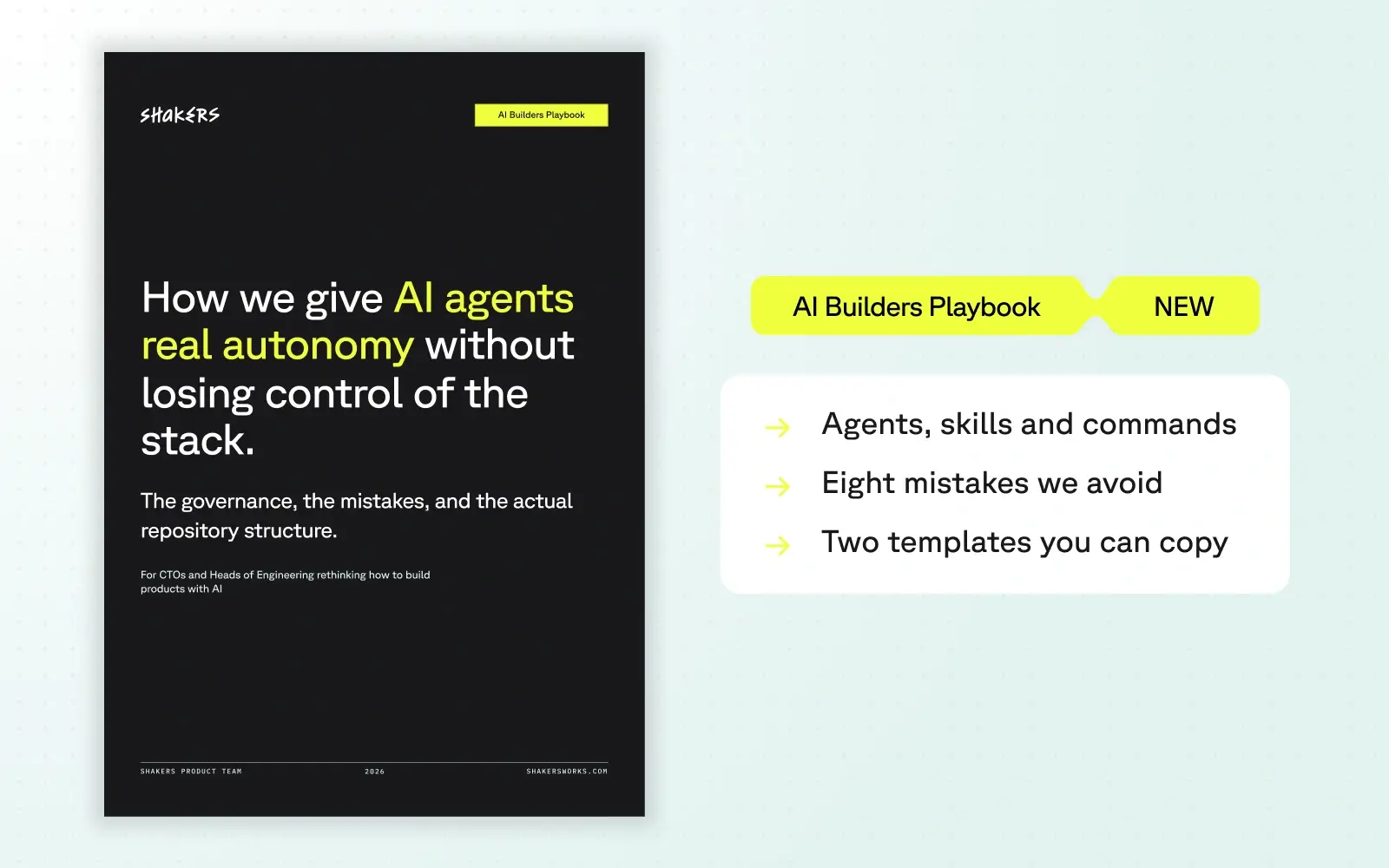
AI Builders sets out what is certified before talent works with a team, from the first specialist to the full team. And if your project already has a budget and the window is open, that is exactly the moment when the ready to build state saves weeks.
Frequently asked questions about ready to build
- Is ready to build a Shakers term?
Yes, in tech talent it is born here: it is the label the platform assigns to talent that has already passed certification and is available to start. The problem it names is not Shakers'; it belongs to any team that has waited weeks to start building with the person it was missing. Telling that apart from the rest of the market is exactly what the term solves.
- Why is it sometimes written ready_to_build, together and with an underscore?
Because it is born as a platform label. The literal ready_to_build is the state the system assigns to the card of certified, available talent, like an order status. In prose it is written apart, ready to build. Both spellings mean exactly the same thing.
- What is the difference between available talent and ready to build talent?
The backing. Availability is declared by the person on their CV; the ready to build state is backed by an external certification process that reviews identity, experience and technical skills. One is a line of text, the other is a certification passed. At start up, one depends on weeks of process; the other, on the match with the project.
- Does the ready to build state apply only to AI talent?
No. It applies to senior tech talent of any family: development, data, cloud, enterprise platforms. The AI Builder is the most visible case because the badge was born alongside that certification, but the condition is the same for any specialist: certification passed, real availability and the ability to join any kind of project.
- What does Shakers certify before marking talent as ready to build?
Three pillars, always in the same order: identity, experience and technical skills. Thousands of professionals apply to join Shakers every year, and only 4% pass the certification process. Whoever carries the badge has already been through the three doors; no paperwork remains ahead, only the match with the project.
- How long does it take a company to start with ready to build talent?
Days, not weeks or months. The slow part of any start with external talent is certifying the person, and with the ready to build state that part is already solved before the project exists: what remains is defining the scope and closing the match. AI Builders has the detail of what is certified in each case.